
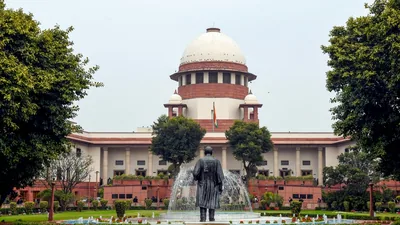
On Wednesday, the Supreme Court indicated that petitions challenging Muslim inheritance rules, which are claimed to be discriminatory towards women, may need to wait for a verdict from a nine-judge bench regarding the 2018 Sabarimala judgment. The court noted that the constitutional questions being examined in both cases could potentially overlap, suggesting a connection between the two legal matters.
A bench, comprising Chief Justice of India (CJI) Surya Kant and justices Joymalya Bagchi and V Mohana, said the nine-judge bench’s decision on the scope of judicial intervention in matters of religion, personal law and custom was likely to “have a bearing” on the challenge to Muslim inheritance and succession rules.
Court Weighs Legislative vs. Judicial Authority on Inheritance Laws
The court is currently deliberating whether the issue at hand should be addressed by Parliament or resolved by the judiciary. This consideration is particularly relevant in the context of Article 25(2)(b) of the Constitution, which empowers the government to enact laws aimed at social welfare and reform, including the opening of public Hindu temples to all castes and classes.
This discussion arises during the hearings of petitions that challenge specific provisions of the Muslim Personal Law (Shariat) Application Act, 1937. These provisions pertain to intestate inheritance and testamentary succession, with petitioners arguing that they unfairly disadvantage Muslim women by granting them smaller shares of inheritance compared to their male counterparts.
Because the nine-judge bench, which reserved its judgment in May after 16 days of hearings, has examined some of the most fundamental questions concerning the relationship between religious freedom and constitutional rights, the court’s suggestion to await the Sabarimala reference verdict assumes significance. The reference arose from review petitions against the 2018 Sabarimala verdict, in which a five-judge bench had permitted women of all ages to enter the Sree Ayyappa temple in Kerala, overturning a custom that barred women of menstruating age. In 2019, the Supreme Court refrained from deciding the review petitions directly and referred a series of broader constitutional questions to a larger bench. These included the interplay between Articles 14, 25 and 26, the scope of religious freedom, the rights of religious denominations and the extent to which courts could scrutinise faith-based practices.
