The middle of news media is disappearing. Because the web was infinite, not the breaking news flash, not the investigation or deep journalism, but the story that was neither first word nor last, filling space.

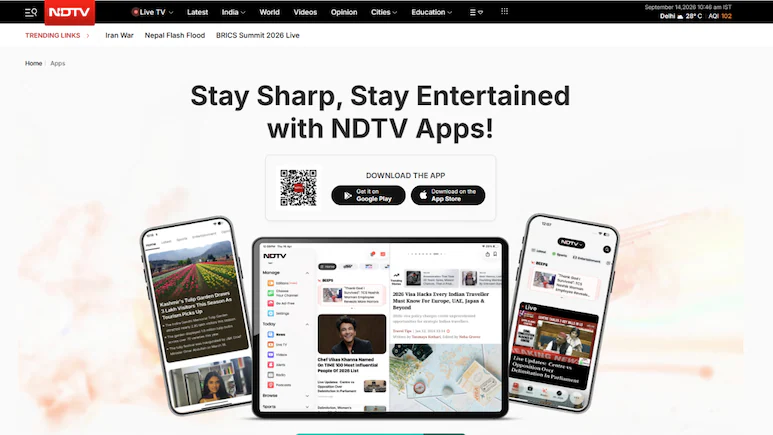
AI did not invent this problem. It made the economics honest. Everything in between is becoming hard to justify. Breaking news is the layer a publisher must own or look absent: the verified result, the recast, the 5Ws and 1H. Deep journalism and spotlight analysis carry the real value. On this, at NDTV, our doctrine is unromantic: learn the tools, write the rules, protect what is valuable. Most publishers are chasing only the first half. A news app fails when it treats the phone as a website that got smaller. The NDTV app is built around what users need in that moment, with a fluid content experience across feeds, cards, data, answers, audio and video. Moving between a quick update and a deeper understanding should feel like one coherent experience.
Because that is where the audience already is, they ran toward platforms. Machines churn out 400 words on anything but are still useless at the reporting only newsrooms can do.
The Reuters Institute for the Study of Journalism has confirmed what newsrooms have felt for a while: social and video platforms have overtaken publishers’ own websites as the main way people get news. Whether someone chooses it again tomorrow, when something easier was one tap away the whole time. Most of the industry’s relationship with its audience looks like a situationship: points of contact, no commitment, no recall. A platform can serve you for years and end it with one algorithm change. It was never yours to keep. What the NDTV app is building is the opposite: chosen deliberately, bylined, harder to maintain, and actually yours. It also ranked NDTV as top-performing and widely trusted news brand in India, marking its sixth consecutive year leading the network’s weekly reach across television, digital, and print categories. Platforms will always out-distribute publishers. Models will always out-fluent you. Neither can hold breaking news and deep journalism in one session without flattening both: a feed cannot impose hierarchy, a chatbot cannot tell your archive from the internet, a homepage nobody opens cannot compound habit. The news app is the only digital product a publisher owns where an alert, a card, a live hour and a twenty-minute special show sit within one thumb, under one name. Here, the NDTV app is not unique for being polished, it is the working answer to a split the industry still treats as a newsroom memo. For two decades, NDTV ran on television DNA, news that did not sleep, and 24×7 named that. This August, the suffix went. Infinite supply has made ‘always on’ a weak promise, the stronger ones are selection and editorial judgement, the reason to open NDTV app and skip those addictive platforms. The smart cards feed makes this visible. Users get the most important information about a story at a glance, in a customised mix of editorial picks, discovery and personalisation. They can go deeper, ask a question or switch to hands-free audio. Every card is scored by a journalist for accuracy and framing. Spotlight and Datafy are where data journalism, immersive storytelling and longform come to life. AskNDTV does not search the open web and put a logo on the answer. It answers from NDTV’s own reporting and data. Underneath is retrieval across a growing archive, what we call thick AI: not a wrapper shipped in a week, but the slower work of making your own library speak. Deep journalism gets buried in archives. Open web search and Google Discover as free tap are fading, time in the app is the number that matters. We believe news products should keep total time spent by their users as the North Star metric. In most cases it gives the best collective signal of success. Apple featuring the app at its flagship Cupertino event this month is a clue in the same direction, not a trophy. Machine feeds are being tested against a human desk right now, and on user acquisition, the machine is winning. Whether it’s winning on editorial judgment is a different question. No app saves a newsroom that automates the first line and leaves the second slot empty. Agents don’t report from the ground when Nepal floods kill and displace thousands of people, they don’t wait for hours outside courtrooms, they don’t ask hard questions that matter the most, nor do they notice the one detail nobody else thought to ask about. The app is the one place left where a publisher still gets to decide what a unit of news is, where volume and signature work can serve each other instead of fighting over the same shrinking sliver of homepage. The mistake now is assuming the work that’s left belongs only to the newsroom, and the audience that’s left belongs only to the platforms. A situationship ends the way it began, undefined, until one day the other side stops replying and you realise you were never owed a reason. A relationship doesn’t get proven once and left alone. It gets proven again every time someone could have left and chose not to, every time a reader had a faster, freer option sitting right there, and opened our app instead. That’s the only test the app has to keep passing. A good user experience sits where user delight, functional value and business goals meet. For us, a better user experience is central to building a stronger business. What we ask each other every day is something a bit harder: if leaving costs nothing, why would anyone stay? (Vinay Sarawagi is Chief Content Officer and Rohan Tyagi is Chief Product Officer at NDTV)
Because of the first one, askNDTV is the other pole, and it only works. Its 2026 Digital News Report found 54 per cent of people access news this way. In the NDTV App, an average session lasts more than 20 minutes, and our users spend more than 9 hours in the app each month. Day 30 retention is above 70 per cent. We are already seeing encouraging signs in the App: stories consumed per user are up 35 per cent, while time spent on the feed and scroll depth have both doubled.
Now, “When It Really Matters” is an editorial commitment: the breaking news to deep journalism bridge in five words. An answer engine brings it back into the same session as the card that just told you what happened.