
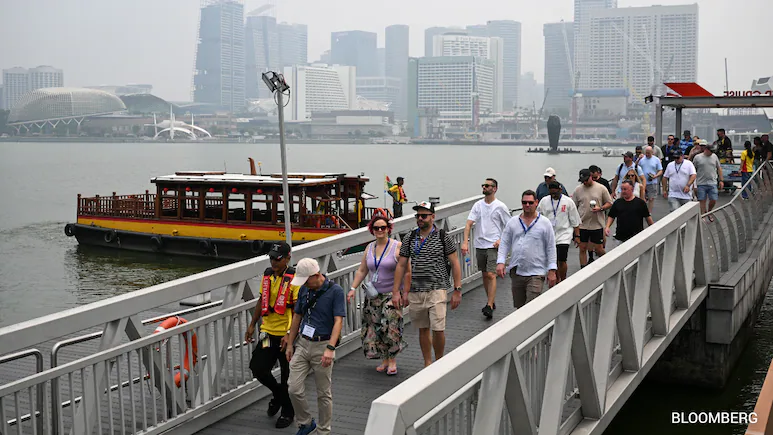
On Tuesday, Singapore experienced significant haze due to smoke from wildfires in neighboring Indonesia. This increase in air pollution has raised health concerns across the island, with pollution levels reaching a point deemed hazardous for residents.
Indonesia often battles wildfires during its annual dry season, but hotspots this year have been higher than normal. Because of a shift in winds, alongside smoke haze from Sumatra, the National Environment Agency said on Monday, smoke plumes from fires in Kalimantan drifted toward Singapore. All five regions of the city-state recorded unhealthy air-quality levels, the first time that’s happened since September 2019, according to the National Environment Agency. Singapore’s air currently ranks among the 10 most polluted cities in the world, according to IQAir data, with the capitals of Malaysia and Indonesia also among the top spots. There were more than 9,000 recorded in August, the most for the month in data going back to 2015, and more than 7,000 have been recorded so far in September, according to the Forestry Ministry’s fire-monitoring platform SiPongi. The agency expects the haze to persist over the next 24 hours, with air quality ranging from high-moderate to mid-unhealthy conditions.
Severe Air Quality Crisis in Indonesia and Malaysia
Air quality in Indonesia’s Kalimantan and Sumatra regions has reached dangerous levels, according to government data released on Tuesday. The situation has worsened due to ongoing fires in these areas. In Malaysia, the effects of the haze prompted the government to shift the National Day speech indoors in late August. Additionally, a state of emergency was declared earlier this month in parts of Sarawak state as a response to the severe air pollution.
The situation is being exacerbated by the strengthening El Nino weather pattern, which causes drier weather in much of the region. A hotspot is defined as a location where satellites detect an elevated surface temperature, indicating a potential fire. The dryness has impacted Indonesia’s vast natural resources sector, with water supplies dwindling at a major nickel complex and palm oil production expected to take a hit.
Little immediate relief is expected from the weather, with dry conditions expected to persist across much of the south of Southeast Asia in the near term, according to the ASEAN Specialised Meteorological Centre.
